News
Contamination, Not Wear, Is What Kills Hydraulic Systems
read time
18/3/2026

Most hydraulic failures come back to dirt, water or air rather than a worn-out fluid. Here's how it gets in, and how to keep it out.
Nobody writes "oil worn out" on a failure report. Pull a year of hydraulic failures off a decent-sized fleet and what you'll find is dirt, water and air, in roughly that order. The oil was usually still fit for service when the pump let go.
It's also the cheapest problem on the maintenance list to fix, which is what makes it frustrating that it's the one most often left alone.
You can't see the particles that do the damage
A servo valve spool works in a clearance of a few microns. Gear pump tooth-to-plate isn't much more. Your eye starts picking up dirt at around forty microns, so every particle capable of writing off a valve walks past a visual check without anyone blinking.
ISO 4406 counts what's really in there. Three numbers, for particles above four, six and fourteen microns in a millilitre. Each step in the code is a doubling of the count, so going from 20/18/15 to 17/15/12 looks like a tidy-up on paper and is an eight-fold cut in the population doing the cutting. Pump and valve manufacturers publish target codes for their components, and after viscosity, that target is the most important number in the system.
Three things get in, and each does its own kind of damage
Dirt. Silt-sized particles cycle through clearances thousands of times an hour, taking a little metal each pass. That metal becomes the next lot of contamination, which is why the failure curve isn't a straight line and why a machine can look fine for a long time and then fail quickly.
Water. Free water rusts things. Emulsified water thins the film and carries the rust around the circuit. Dissolved water goes after the additive chemistry through hydrolysis, so the anti-wear performance is reduced long before the oil looks any different on a dipstick. If a sample comes back cloudy, you're already late.
Air. Entrained air makes the fluid compressible, so actuation softens and positioning drifts. It also collapses hard at the pump inlet, and cavitation takes metal off pump internals at a rate no additive package will protect. Oxidation needs oxygen and heat, and a bubble at a hot pump inlet delivers both at once.
Where it comes from
Almost never from the drum sitting in the store. Almost always from ordinary work.
• New oil isn't clean oil. Delivered fluid is often several ISO codes dirtier than the target for the system it's going into, because nobody filtered it for your machine on the way through.
• Breathers. A retracting cylinder pulls air in through whatever the breather will pass, and a standard mesh breather on a dusty site is a hole with a formality of protection attached.
• Rod seals. Every extension puts a rod out into the dust and mud, and every retraction wipes some of it inside. A weeping seal is an ingress path in both directions.
• Top-ups. A dirty funnel, an open drum, a jug that had something else in it last month. Biggest avoidable source on most sites and it costs almost nothing to fix.
• Hose and component changes. Ten minutes with an open circuit out on site puts more in than the breather manages in a year.
What to do about it
1. Set a target cleanliness code for each critical system, taken from the component manufacturer's requirement rather than picked for convenience.
2. Filter the oil going in, not only the oil already in. A filter cart costs less than one pump, and that's the whole business case.
3. Buy filters on beta ratio at the micron size you care about. "Nominal ten micron" is marketing rather than a specification.
4. Fit desiccant or high-efficiency breathers wherever there's dust or humidity, and put them on a replacement schedule so someone owns them.
5. Use dedicated, sealed, labelled transfer gear. One jug per fluid, lid on.
6. Sample properly. Live line, under pressure, upstream of the filter, at operating temperature, same point every time. A sample out of the bottom of the reservoir tells you about the bottom of the reservoir, it is not representative.
7. Trend it. A single report will either scare you or reassure you, and neither reaction is worth much without the two before it to compare against.
What the oil should be doing for you
Contamination control is a system discipline, but the fluid either helps or gets in the way.
• Demulsibility. Water needs to separate fast and settle in the reservoir where it can be drained off, rather than going round as an emulsion.
• Air release and foam control. Air has to come out of solution inside the dwell time the reservoir gives it, and on mobile plant with a small tank that isn't long.
• Filterability. The oil has to pass fine filtration without shedding additive or plugging elements early, including when there's a little water in it.
• Oxidation resistance. Group II base oil technology resists the varnish that makes valve spools stick, which keeps the system responding the way it was designed to for longer.
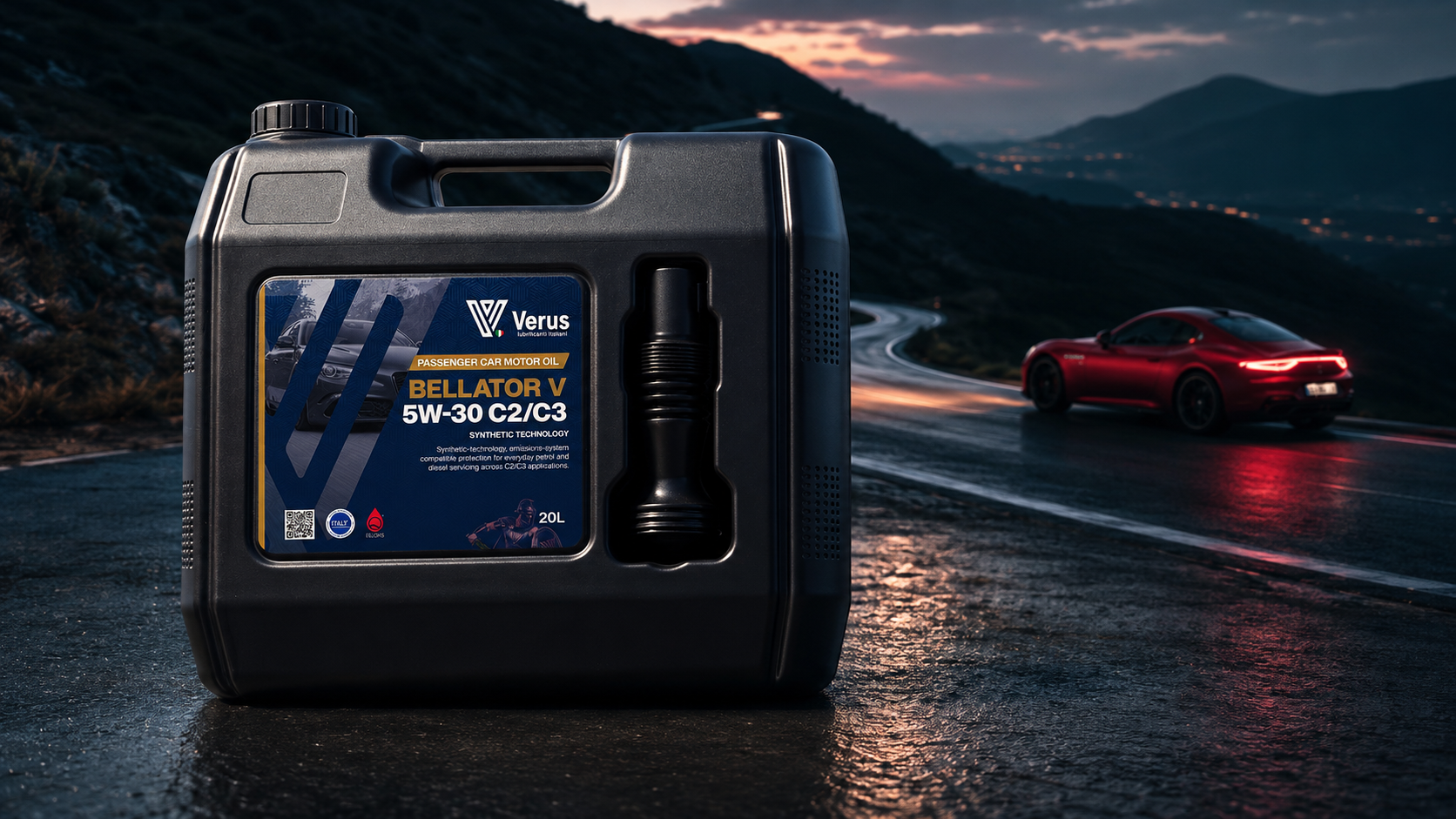
Verus Arena hydraulic oils are formulated on Group II base stocks and meet the requirements of DIN 51524 Part 2 (HLP), ISO 6743-4 HM, Denison HF-0, HF-1 and HF-2, and Vickers I-286-S.
Contamination is the biggest single cause of hydraulic failure, so we'll talk to you about filtration, breathers and cleanliness targets as readily as we'll talk about the oil.
Keep reading


Contact us
Contact us for product enquiries, technical support or partnership opportunities.